Local co-ethnic business networks and school-to-work transitions among the second generation
With Martin Ehlert, Benjamin Schulz and Alexander Dicks
What role do “ethnic” labor markets play in the school-to-work transitions of minority youth? We study how occupational aspirations and school-to-work transitions among second generation high-school students are affected by the local presence of businesses founded or headed by co-ethnic entrepreneurs. We combine geocoded survey data from the German National Educational Panel Study with data on business organizations drawn from the official trade register, which we augment using digital tools and with process generated data from an online service provider. We employ a choice-modelling framework and tackle selection and unobserved confounding using a fixed-effects approach.
Regional origin predicts transnational voting behavior of Turkish immigrants in Germany
With Mareike Heller and Serhat Karakayalı
Voters residing abroad are often an important electoral factor in the politics of countries with large emigrant diasporas. However, little is known about the dynamics shaping the expatriate vote. In this study we focus on the regional origins of voters residing abroad and show that regional cleavages in the sending country shape expatriates’ transnational voting behavior. Empirically, we focus on emigrants from Turkey, a country with politically salient regional cleavages, in Germany, and on the Turkish parliamentary election in 2018. We link data on the regional origins of Turkish immigrants from the German register of foreign persons to election results on the consulate-level in Germany. We show that the Turkish diaspora in Germany is heterogenous in terms of regional origin, and, thus, political orientations. This origin-regional composition varies over German regions, and predicts consulate-level election results. By demonstrating the continuing relevance of origin-specific factors, our results speak to the debate on migrant transnationalism. We furthermore add an original empirical assessment to the controversial debate on the Turkey-related voting behavior of Turkish citizens in Germany, and show that their conservative leanings largely reflect regional origins within Turkey.
Social reproduction among children of immigrants in Europe
With Nhat An Trinh
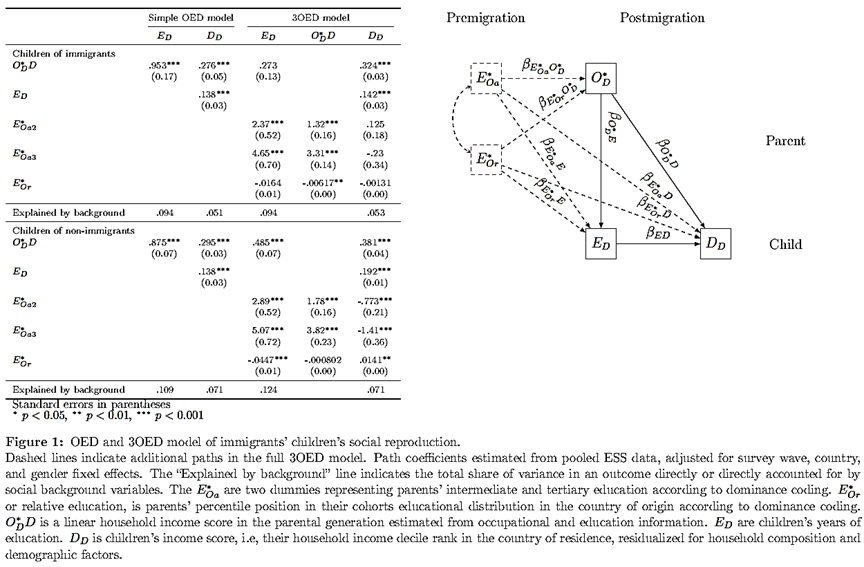
A wealth of empirical studies demonstrates that children of immigrants in Europe have lower levels of education, work less-skilled jobs, and receive lower incomes than children of native-born parents. But social science research has also sought to establish a second stylized fact: that children of immigrants are exceptionally socially mobile. Against this background, our objective is twofold: Firstly, we argue that the social origin of immigrants’ children is complex and comprises elements from the country of origin and the country of destination. We, therefore, propose to extend the classic Origin-Education-Destination (OED)-triangle into what we call the 3OED-pentagon. This extension allows us to precisely distinguish between pre- and post-migration mechanisms to study migration-specific aspects of intergenerational status transmission. Secondly, we draw on five pooled waves of the European Social Survey (2002-2010) to empirically explore three complementary explanations for reportedly higher social mobility among children of immigrants in previous research. The first hypothesis is that low estimates of social reproduction in previous research are measurement artefacts. We test it by comparing results from the conventional OED model to our extended 3OED model. Our second hypothesis argues that lower social reproduction is a substantive feature of the migration processes. Migration devalues various resources of the parental generation, which in turn reduces opportunities for higher status immigrant parents to confer advantage. We test this hypothesis through decomposition and simulation techniques. Our final hypothesis argues that social reproduction among children of immigrants and natives is in fact similar, but that immigrant parents tend to settle in regions which are generally conducive to their children’s upward mobility. To test this explanation, we rely on regional fixed-effects. Results of our analyses suggest that higher social mobility of the children of immigrants is a substantive feature of the migration process.
Environmental quality, local infrastructures, and residential choice: A survey experiment on ethnic differences in neighborhood preferences
With Christian König, Jan Paul Heisig, Merlin Schaeffer and Tobias Rüttenauer
Stratification research increasingly recognizes that inequalities are location dependent, that is, clustered in space, with neighborhoods often being the locus of inequality . One crucial dimension of spatial inequality is environmental quality (e.g., pollution levels or proximity to green spaces). Environmental quality at the place of residence has been shown to affect health and life chances more broadly. From the literature on “environmental justice”, we know that some population subgroups are disproportionately exposed to environmental hazards at their place of residence. The processes that underlie this empirical regularity are not well understood, however. Studies have shown that ethnic minorities bear a disproportionate burden of environmental hazards at the neighborhood level, even after controlling for income and other aspects of socio-economic status. Therefore, purely economic explanations of selective in- and out-migration appear insufficient for explaining the spatial distribution of environmental goods and bads observed. We develop a conjoint survey experiment aimed to test the role of residential preferences as a possible explanation of population sorting that is difficult to assess with observational data. Within our survey experiment, respondents of immigrant and non-immigrant origins will be presented with several pairs of neighborhood profiles and will be asked to choose in which of these neighborhoods they would rather live in. The different neighborhood profiles will be random combinations of several key attributes that might affect residential choices. The experiment allows us to separate, and thereby disentangle, the role of factors that are empirically correlated, most importantly environmental quality and the presence of co-ethnics and ethnic infrastructures.
Ethno-religious minority infrastructures:
Why do some immigrant minorities build dense organizational infrastructures while others do not?
With Merlin Schaeffer, Sarah Carol, and Susanne Böller.
Currently under review.
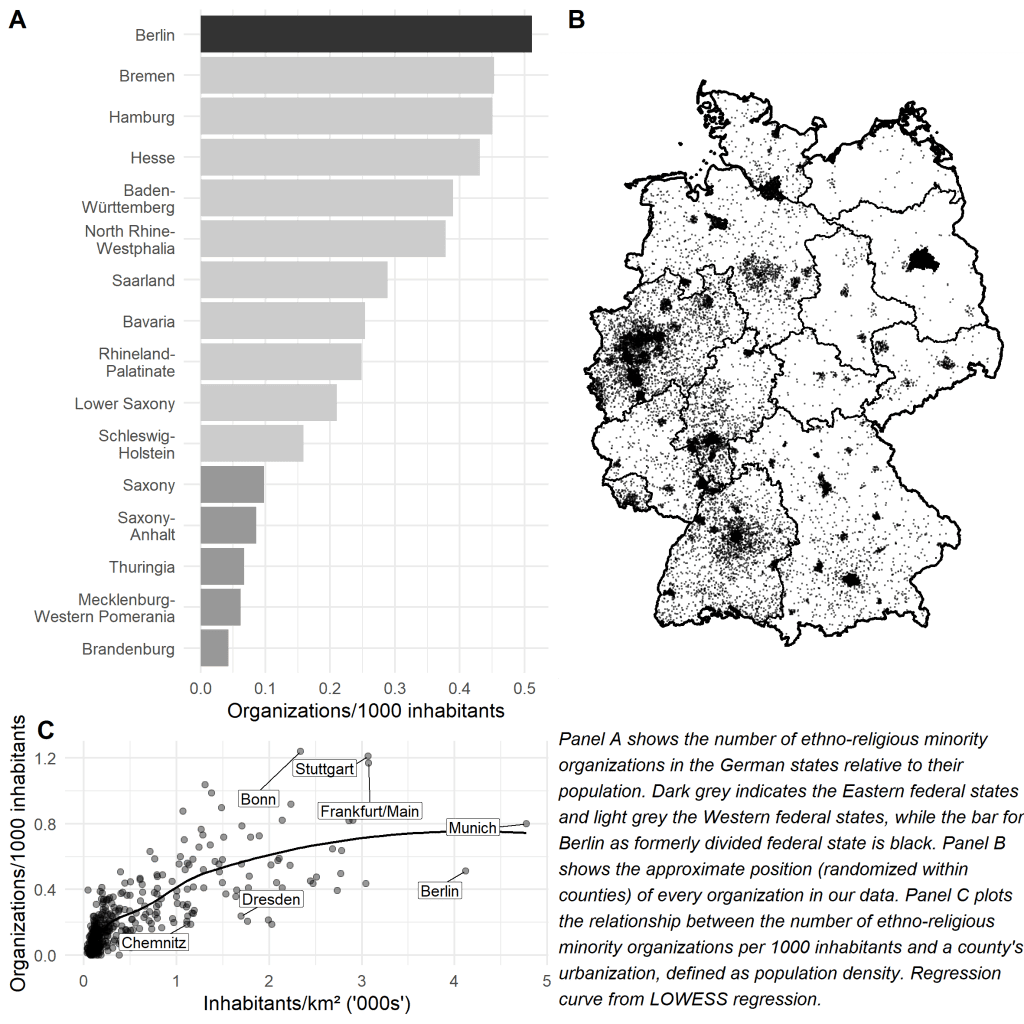
Why do some immigrant minorities establish dense ethno-religious infrastructures, while others do not come together as organized communities? This question links a central topic of ethnicity scholarship with an important tradition of urban sociological research on immigrant enclaves. The authors combine arguments about internal demand, within-ethnic heterogeneity, and socio-economic resources with a regard for external constraints imposed by anti-minority mobilization to identify the conditions under which nominal co-ethnicity leads to formal minority organization. To test their framework, the authors draw on a novel geo-coded dataset of 25,117 ethnic businesses and ethno-religious organizations catering to 61 immigrant minorities across Germany. The article demonstrates strong variation in the density of organizational infrastructures across minorities. The results suggest that initial cultural distance to mainstream society drives the establishment and maintenance of ethno-religious infrastructures and also underline the pivotal role of religion.
 Jonas Wiedner